Student International
Talk through your options
China · English

Clear study abroad planning, made for students in China.

For students preparing university study abroad from China — whether you are working through Gaokao or Huikao, sitting A Levels, IB, or AP, completing a foundation route, on a Sino-foreign programme, finishing an international school year, or moving on from an undergraduate degree. We help turn your pathway into a clear, family-aware plan with the timing, budget in RMB, sponsorship realities, and major-city visa logistics built in from the start.

Studying abroad from China is shaped by decisions that do not appear on a generic study abroad page: which pathway you are on, when your results land, whether the plan is self-funded or sponsored, what the budget looks like in RMB, and how a major-city appointment in Beijing, Shanghai, Guangzhou, or Shenzhen fits into the visa and travel timeline.

Our role is to make those decisions feel ordered rather than rushed. We work alongside students and parents in China to map the pathway, sequence the steps, and protect the choices that matter most along the way.

What changes from China

Five pressures that shape the plan.

Most students from China are not weighing only a destination. They are weighing five practical decisions at the same time, and the order in which those decisions are taken often matters as much as the answers themselves.

This is the lens we begin every conversation with — so the first conversation is grounded in your actual situation, not a generic checklist.

  • Pathway and entry route — Gaokao, Huikao, A Level, IB, AP, foundation, Sino-foreign programme, international school, and undergraduate degree routes each open different overseas destinations on different timelines.
  • Result-to-intake calendar — Gaokao results and Chinese school graduation around June, A Level in August, IB in July, AP in July, set against UK September, Australia and New Zealand February or July, US August or September, and European intakes that vary by university.
  • Self-funded or sponsored — family funding, bank support, employer support, China Scholarship Council routes, provincial or municipal schemes, and university awards each follow different sequences, where current rules allow.
  • RMB budget framing — tuition, living costs, deposits, flights, and visa preparation read differently in RMB than in destination currency, especially as exchange rates move during the planning year.
  • China-side logistics — major-city appointments handled from Beijing, Shanghai, Guangzhou, or Shenzhen, document translation and certification, and the practicalities of leaving home for the first time across long distances and time zones.
Where to begin

Two ways to explore.

Some students arrive knowing the country. Others arrive knowing the kind of support they need. Pick the route that matches where you are today.

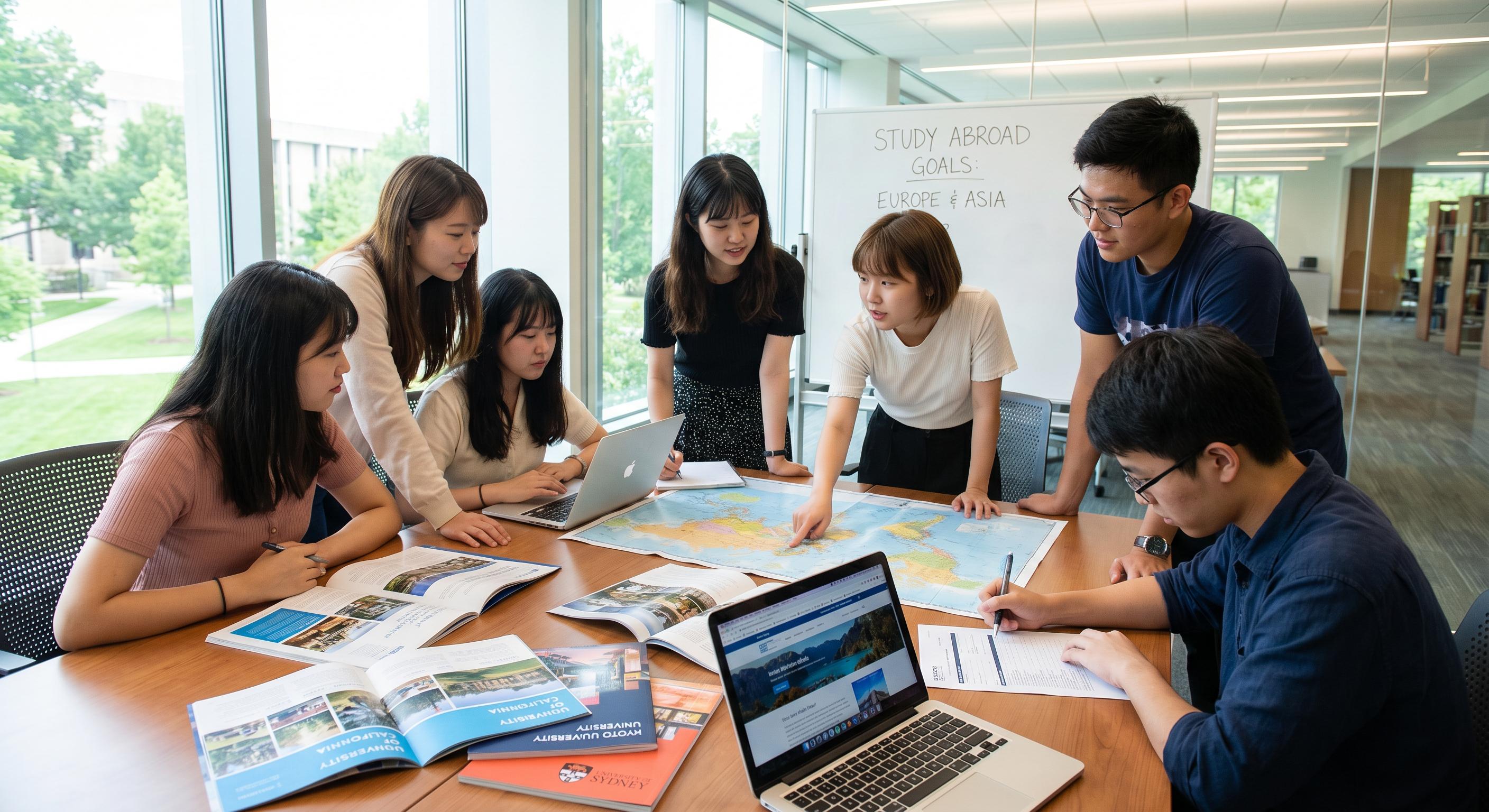
A student planning study abroad goals on a laptop at a study desk.

Explore by service.

If you already know what you need help with — applications, scholarship and sponsorship sequencing, the visa, or staying supported through the year — start with the China services hub.

  • Application support and personal statements
  • Scholarship guidance and sponsor sequencing
  • Study visa preparation from China
  • Mentorship, tuition, and welfare planning

See study abroad services for Chinese students
A signpost pointing to international university city destinations.

Explore by destination.

If you are still comparing destinations, start there. Each page covers what study, daily life, costs, and the application timeline actually look like from China.

  • United Kingdom — the first detailed route from China
  • Australia and New Zealand — semester-aligned alternatives
  • United States and Canada — broader course profiles
  • Europe and beyond — English-taught and value routes
Compare destinations from China
How we work

A planning approach grounded in your starting point.

Four stages take you from where you are now in China to a confident first day abroad — with the same adviser involved end to end.

  1. 1

    Map your starting point.

    Begin with your current pathway, your result month, your self-funded or sponsored plan, and your family decision context. The plan is built outward from where you actually are, not from a generic profile-and-goals discovery.

  2. 2

    Match destinations to your timeline.

    Compare destinations and entry routes against your result month, your pathway, and your RMB budget — so the shortlist is one your timeline can realistically support, not one that forces a scramble.

  3. 3

    Sequence applications, funding, and visa.

    Manage university applications, scholarship or sponsor confirmation, and visa document readiness as one connected timeline — because for most students from China these stages are interlocked, not separate.

  4. 4

    Stay supported through arrival.

    Continue alongside the student through accommodation, departure timing from a major Chinese city, and the first weeks abroad — keeping family informed back in China across the time-zone gap, without taking the lead away from the student.

Begin

Start with a clear next step, from China.

A first conversation is short and obligation-free. We listen first, share what we see, and outline the next two or three practical steps to take — together with the family if that helps.